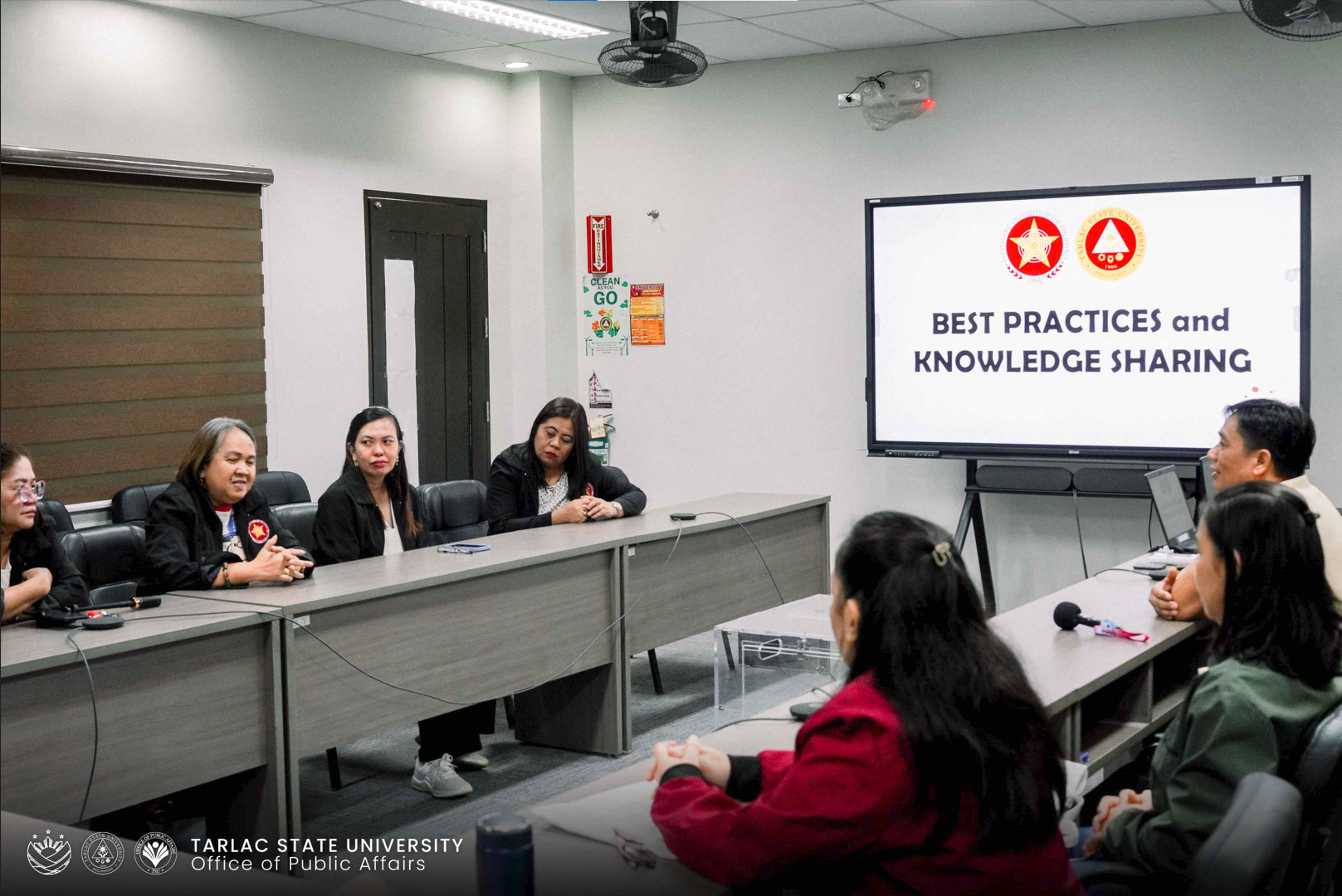
Tarlac State University strengthened knowledge-sharing and institutional collaboration through separate benchmarking activities with the Polytechnic University of the Philippines (PUP) on October 15 and Pampanga State University (PamSU) on October 21, focusing on internal audit practices, planning, and institutional controls.
The PUP delegation was led by Internal Audit Office Director Prof. Realin C. Aranza. Meanwhile, the PamSU delegation included Internal Auditor II Alvin A. Vital and Internal Auditors I Dianne D. David and Ma. Christina A. Limlingan.
University President Dr. Jasper Jay N. Mendoza welcomed the PamSU delegation and expressed hope that the activity would foster mutual learning and collaboration between the two institutions.
During the sessions, TSU Internal Audit Services (IAS) Director Dr. Jonathan A. Gabriel discussed the university’s implementation of the Baseline Assessment of Internal Control System (BAICS), a planning tool under the Revised Philippine Government Internal Audit Manual (RPGIAM) that helps identify operational areas with weaknesses or gaps in internal controls and prioritize audit engagements.
Implemented in 2013, TSU’s BAICS is revisited every three years to incorporate improvements and account for newly established offices and units.
Dr. Gabriel also presented the office’s three-year strategic plan, which integrates BAICS, internal audit risks, mandatory audits, Commission on Audit (COA) audit foci, and the university’s DALAN framework.
During the benchmarking with PamSU, TSU Internal Auditor II Ms. Amelia A. Pamposa discussed the office’s audit process, from audit planning, fieldwork, reporting, and follow-up.
The team also presented some of its innovations and best practices such as the comprehensive BAICS, standardized audit guide, and cash advance monitoring system, among others, which aim to strengthen internal controls and improve audit efficiency.
Moreover, Dr. Gabriel emphasized the importance of thorough preparation in conducting audits, noting that a complete engagement typically takes two to three months.
"Planning is the most important part of audit execution," he said.
He also highlighted the need for proper documentation throughout the process, from entry to exit conferences, and the use of audit condition sheets to promptly communicate observations to auditees.
Established on February 13, 1995, TSU IAS conducts 10 to 12 audit engagements annually and continues to align its operations with the university’s strategic direction and institutional priorities under the DALAN framework.