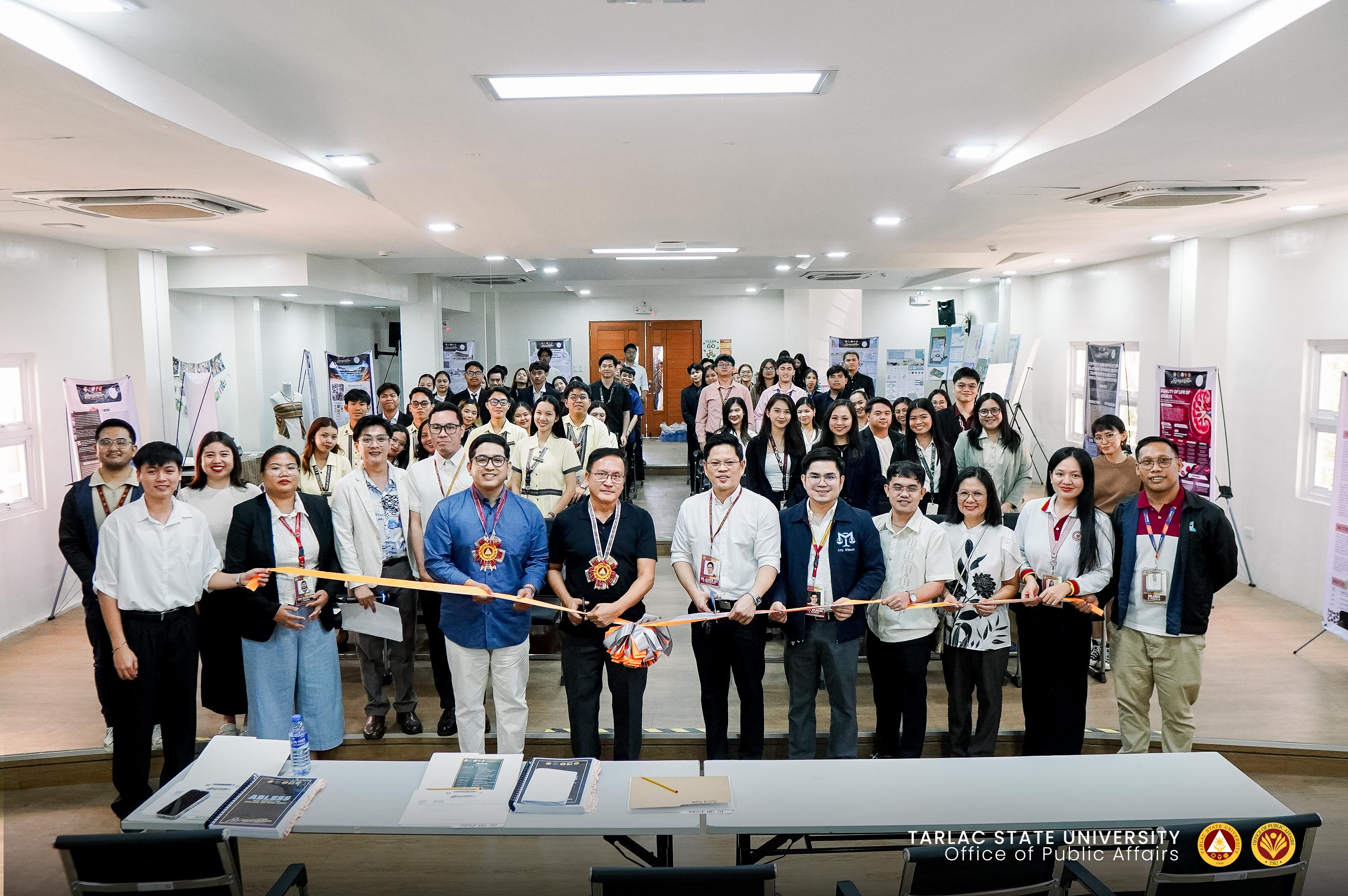
Seventeen (17) entries for the Arts, Business, Law, Education, and Social Sciences (ABLESS) category competed during the 6th Saliksiklaban on Monday (May 25) held at the Center for Food Technology and Research AVR, Lucinda campus.
Saliksiklaban is a university-wide undergraduate research competition that provides students with an avenue to develop social intellect, creative thinking, and innovation, and to foster a strong research culture in the university while inspiring them to conduct evidence-based research.
This student-faculty partnership may be lined up for Intellectual Property rights (copyright or patent), which can also be adopted, transferred, or commercialized, depending on the needs of the community.
“Research must never end in the archive; too many find studies in this country are bound [to a] shelf and never open again. In fact, part of the DALAN program is to utilize our research, community-based research," University President Dr. Jasper Jay Mendoza said in his speech.
The ABLESS category (day 1) was paneled by Dr. Kenneth Armas, Director of the Planning and Development Office at the Nueva Ecija University of Science and Technology (NEUST), Dr. Joseph Richard Mejia, an author and full-time professor at PHINMA University of Pangasinan, and Dr. Danzen B. Olazo, Associate Professor II, Department of Management of Holy Angel University.
“Tarlac State University has set its eyes on becoming a globally recognized, research-intensive university. One that advances an inclusive education, sustainable innovation, and transformative community partnerships,” President Mendoza told the student researchers.
Some of the competing teams include the research titled, “Visual Documentation of Bingala Accessories: Promoting the beauty and cultural significance of traditional Aeta handicrafts in Capas, Tarlac” by the Fine Arts students John Vincent David and Mihaira Cielo.
David said they walked for two hours to reach the community to conduct the research that they documented in a coffee table book. They aim to promote bingala accessories to the public to help the Aeta community commercialize their products and turn them into an income-generating project.
Another entry is the “Institutional Integration: An access to quality patient-centered healthcare facilities manifesting evidence-based design towards access and expansion”, by the Architecture students Adenson Dayrit, Christine Saguinsin, Limuel Barin, and Marisol Lacayanga.
The research is a proposed municipal-level 2 hospital in Capas. The group displayed a miniature of the structure named “Formada por Capas: A Protective Architecture of Healing”, a general hospital whose design was inspired by “Kapas” or the cotton tree.
Organized by the Office of Innovation and Business Development, the 6th Saliksiklaban features thirty-seven (37) competing teams from ABLESS and Science, Technology, Engineering, and Mathematics (STEM) categories.
This year’s entry exceeded the thirty-one (31) teams from the previous year.
According to Atty. Wilmark J. Ramos, Vice President for Research, Innovation, and Extension, the STEM category is outnumbered and signifies good progress among researchers.
The STEM category entries will be evaluated tomorrow, May 26, 2026.
Winners will receive cash prizes for the STEM category: first prize is 10,000 pesos, second prize is 7,000 pesos, and third prize is 5,000 pesos; while for the ABLESS category: first prize is 7,000 pesos, second prize is 5,000 pesos, and third prize is 3,000 pesos.
As one of the partner offices of the event, the Office of Gender and Development will also select the most gender sensitive research for both categories.
Photos by: Mr. Franc Lewis R. Juanatas